Exploring AI Tools for Accessible Scientific Documents
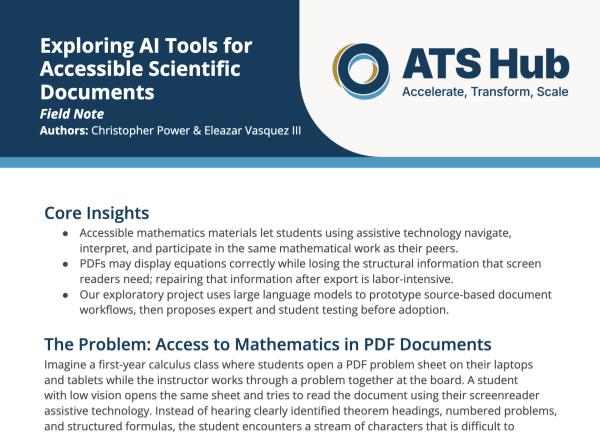
Authors: Christopher Power & Eleazar Vasquez III https://doi.org/10.51388/20.500.12265/326 Abstract: This field note addresses the critical challenge of accessing mathematical content in PDF documents for students using screenreader technology. Standard PDF exports often discard structural tags and fail to convey the complex meaning of mathematical notation, hindering full student participation in learning activities. To overcome these … Read more
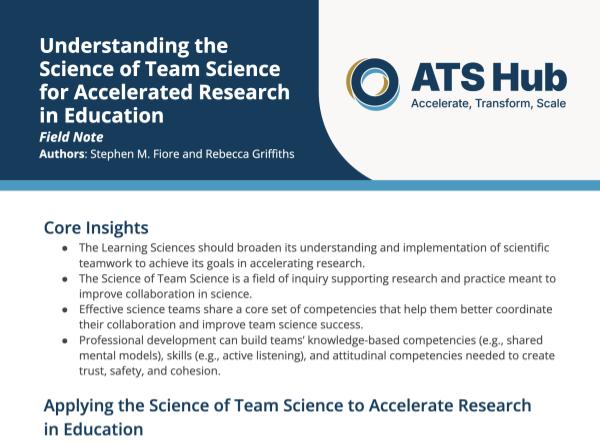
Understanding the Science of Team Science for Accelerated Research in Education

Authors: Stephen M. Fiore and Rebecca Griffiths doi.org/10.51388/20.500.12265/325 Abstract: Teamwork, not just technical expertise, determines whether interdisciplinary education research succeeds. The Learning Sciences have always been interdisciplinary, bringing together researchers, educators, and developers who hold different epistemologies, values, and standards of evidence. These differences often show up as teamwork problems that weaken trust, communication, and … Read more

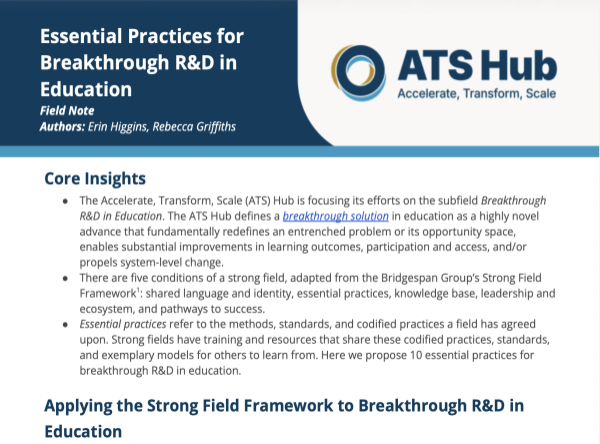
Essential Practices for Breakthrough R&D in Education

Cover for the ATS Field Note —Essential Practices for Breakthrough R&D in Education

Authors: Erin Higgins, Rebecca Griffiths https://doi.org/10.51388/20.500.12265/312 Abstract: To support the development of a robust, coordinated field of education innovation, this field note outlines the essential practices for Breakthrough R&D in Education. The Accelerate, Transform, Scale (ATS) Hub defines breakthrough solutions as novel advances that fundamentally redefine persistent educational challenges and drive system-level change. By adapting … Read more

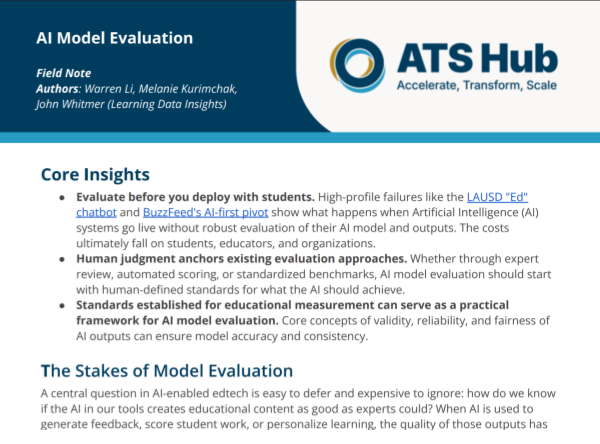
AI Model Evaluation

Cover for the ATS Field Note —AI Model Evaluation

Authors: Warren Li, Melanie Kurimchak, and John Whitmer https://doi.org/10.51388/20.500.12265/300 Abstract: The rapid integration of Artificial Intelligence into educational technology necessitates a rigorous approach to model evaluation, as the consequences of unchecked AI systems fall heavily on students, educators, and organizations. When AI tools are deployed to individualize learning, score student work, or generate feedback without … Read more

The UX Design Loop

Cover for the ATS Field Note —UX Design Loop

Authors: James Gartrell and Erik Johnson https://doi.org/10.51388/20.500.12265/299 Abstract: This field note introduces the 5-Phase user experience (UX) Design Loop as a transformative framework for education R&D teams. As AI technologies accelerate development cycles, this methodology helps teams navigate the shift from traditional static design to rapid, code-first prototyping. The loop emphasizes a cyclical, iterative process: … Read more

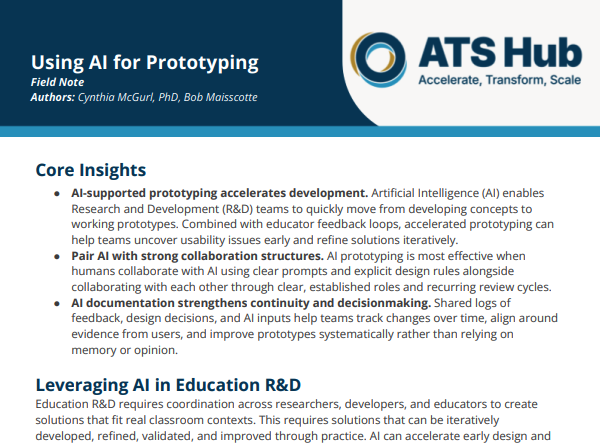
Using AI in Prototyping

Cover for the ATS ATS Field Note —Using AI in Prototyping

Authors: Cynthia McGurl, PhD and Bob Maisscotte https://doi.org/10.51388/20.500.12265/298 Abstract: Education Research and Development (R&D) demands efficient methods to bridge the gap between conceptualization and district-, school-, or classroom-ready solutions. This field note examines how AI-supported prototyping accelerates development, enabling R&D teams to transition from ideas to functional, testable tools. By integrating AI into structured workflows, … Read more

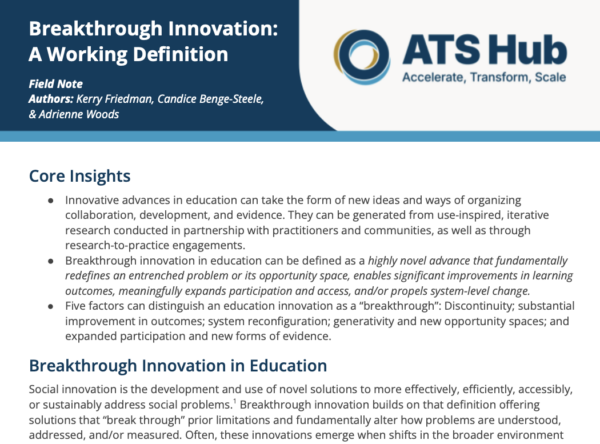
Breakthrough Innovation: A Working Definition

Cover for the ATS Hub Field Note Breakthrough Innovation: A Working Definition with a blue header and the ATS Hubs logo then text of the field note

Authors: Kerry Friedman, Candice Benge-Steele, Adrienne Woods https://doi.org/10.51388/20.500.12265/297 Abstract: Breakthrough innovation in education requires more than incremental improvement, it demands fundamental shifts in how problems are understood, addressed, and measured. This field note presents a working definition of breakthrough innovation in education as a highly novel advance that redefines entrenched problems, enables significant improvements in … Read more